Saturation vs distortion: what harmonics, clipping and aliasing actually do
Saturation, overdrive, distortion and clipping are one process at different strengths. How the curve sets the harmonics, and why oversampling matters.
By CrystalKarat14 min read
Saturation, overdrive, distortion, clipping: four words that are used as if they were four effects. They are one effect at different strengths, and once you can see what it does to a waveform, choosing between plugins, or between the settings on one, stops being guesswork. This guide goes from the curve to the harmonics it creates, why distorted chords go muddy, what tape and transformers add that a simple curve doesn’t, and why oversampling matters.
One process, four names
All four are nonlinear processing: the output is not simply a scaled copy of the input. Push a signal through a curve that bends, and it comes out with new frequencies in it. What we call it depends on how far it goes:
- Saturation: a soft curve, driven lightly. A few low harmonics, mostly felt as density and warmth rather than heard as distortion. Typically well under 1% to a few percent total harmonic distortion (THD).
- Overdrive: the same soft curve, pushed until the bend is audible. The source still sounds like itself.
- Distortion: harder clipping, more and higher harmonics, an obvious effect.
- Fuzz: clipping so hard the wave approaches a square.
Clipping is the mechanism underneath all of them: the moment the curve stops the signal growing. Soft clipping does it gradually, hard clipping does it at a corner. The boundaries are informal, and a single plugin with one drive knob can cover the whole range.
The curve is the sound
Every saturator has a transfer curve: a graph of output level against input level. A clean signal path is a straight diagonal line. A saturator follows that line near the middle, where quiet signals live, and bends away from it as the signal grows, so it leaves low-level detail alone and acts on the peaks. Drive moves the signal further up the curve; it doesn’t change the curve.
Three properties of the curve decide most of what you hear:
- The knee. A gradual bend (the shape of a hyperbolic tangent, the textbook soft clipper) produces harmonics that fall away quickly with order. A sharp corner produces a long run of high harmonics that fall away slowly, roughly in proportion to 1/n for a fully clipped sine, the same series as a square wave.
- Symmetry. Whether the positive and negative halves bend the same way. This decides even against odd harmonics, below.
- What surrounds it. Filters before and after, how the curve depends on frequency, and whether it remembers the recent past. That is where tape, transformers and valves differ from a bare curve.
Even and odd harmonics
A curve that is symmetrical about the middle (mathematically an odd function, f(−x) = −f(x)) can only add odd harmonics: three, five, seven times the input frequency. Bend one half more than the other and even harmonics appear too: two, four, six times. That is the whole difference, and you can hear it in the demo below: pick a character, raise Drive, then move Bias and watch the even harmonics, drawn in amber, climb.
Transformer
A soft clip on a flux model: bass saturates the core before treble.
Best forIron, punch, the drum bus
Why the two kinds sound so different comes down to musical intervals:
| Harmonic | Interval above the note | Character |
|---|---|---|
| 2nd | One octave | Fuller, the same note: reads as warmth |
| 3rd | An octave and a fifth | Still consonant: adds presence and edge |
| 4th | Two octaves | Brightness that stays in tune |
| 5th | Two octaves and a major third | Colour; the start of grit |
| 7th | Two octaves and a flat minor seventh, about 31 cents below equal temperament | Out of tune with the scale: harshness |
| 9th, 11th, 13th… | Ever closer together, several between scale notes | Buzz and fizz |
Even harmonics are octaves and their consonant relatives, so they thicken a sound without changing what note it seems to be. Low odd harmonics add presence; high odd harmonics, the ones a hard curve produces in quantity, are where harshness lives. A gentle, slightly asymmetric curve is what most people mean by “warm”.
Two cautions. Asymmetry also shifts the signal off centre (a DC offset), which a good plugin removes and a poor one leaves eating your headroom. And “bias” means two different things: in a saturator like Forge or IVGI it is the asymmetry control; in a tape machine it is an ultrasonic tone mixed with the recording to make the tape behave more linearly.
Intermodulation, or why guitarists play power chords
Harmonics are only half the story. Put two notes through a curve together and it also creates intermodulation products: tones at the sum and difference of the two frequencies (from asymmetric curves) and at combinations such as twice one minus the other (from symmetric ones). Unlike harmonics, these aren’t multiples of either note.
Whether they sound musical depends on the interval. Take a power chord, A2 at 110 Hz and E3 at 164.8 Hz. Their difference is 54.8 Hz, almost exactly A1: the products land on notes of the chord’s own harmonic series, so the distortion sounds like a bigger chord. Now take a major third. The products land near, but not on, the notes of the series, because an equal-tempered third is about 14 cents away from the pure 5:4 ratio, and the near misses beat against each other. Drive it hard and a major chord turns to mush, which is why distorted guitar parts are built on fifths and octaves.
In a mix the same thing happens between every element sharing a saturator. A bass note and a vocal through one curve intermodulate; the louder the bass, the more it modulates the vocal’s distortion in time with itself. That is the case for multiband saturation: fewer notes per band, fewer products, and the bass no longer drives everything above it.
Tape, iron and valves: frequency and memory
A bare curve treats every frequency the same and forgets each sample as soon as it has passed. Real gear does neither, and that is most of what plugins mean by “analog”.
Transformers and tape saturate bass first
Both work on magnetic flux, and flux is the integral of the signal over time. For the same level, a low note spends longer in each half-cycle, so it builds more flux: a 50 Hz tone drives the core ten times harder than a 500 Hz tone at the same voltage. So iron and tape thicken and round off the low end while leaving the top clean, a frequency-dependent saturation no single curve can produce. Forge’s Transformer and Warm Tape model this by shaping an integrated flux signal; transformer plugins such as Kazrog’s True Iron model specific units.
Tape has memory, and loses its top
Magnetic tape doesn’t just saturate; its magnetisation depends on its recent history, a loop called hysteresis. It also loses high frequencies through the gap in the playback head and the tape’s own self-erasure, and adds a low-frequency bump from the head’s shape. A static curve with a filter gets you some of the way; a hysteresis model such as ChowTape gets you the memory too.
Valves sag
Single-ended triode stages bend asymmetrically and lean towards the second harmonic. Push-pull output stages cancel even harmonics, which is part of why a pushed power amp sounds harder than a pushed preamp. Drive a valve circuit hard and its supply and bias shift under the load, so the distortion breathes with the music. Forge’s Analog deck imitates this kind of load-dependent behaviour (sag, darkening, dropouts) on top of its curves.
Saturation is compression too
Because a saturator squashes peaks more than the body of the sound, it lowers the crest factor, the ratio of peak to average level. A drum loop might have a crest factor of 15 to 20 dB; saturation can take several decibels off it, so at the same peak level the loop measures, and sounds, louder and denser. That is real, useful compression, and it is why light saturation on a bus can replace a compressor.
It is also a trap. Ears hear louder as better, so a saturator that adds level will win every unmatched comparison, whether or not it improves the sound. Analog stages keep some of the level they add, and good plugins model that, but you should still match levels before you judge.
Aliasing, oversampling and ADAA
Digital audio can only hold frequencies up to half its sample rate, the Nyquist frequency: 24 kHz at a 48 kHz session. Saturation creates harmonics with no regard for that limit, and any above it don’t disappear; they reflect back down into the audible range as aliasing, at frequencies that are not harmonics of anything.
Take a 5 kHz tone through a hard curve at 48 kHz. Its 3rd harmonic, 15 kHz, is fine. The 5th, at 25 kHz, folds back to 23 kHz; the 7th, 35 kHz, to 13 kHz; the 9th, 45 kHz, all the way down to 3 kHz, well below the note itself. On bright, hard-driven material that becomes a grainy, clangorous haze. On subtle saturation of bass it is negligible, because those harmonics are tiny.
| Technique | How it works | Cost |
|---|---|---|
| Oversampling | Run the curve at 2 to 32 times the sample rate, filter off everything above the original Nyquist, and come back down | CPU and latency; the filters can be minimum-phase (less latency) or linear-phase |
| Antiderivative antialiasing (ADAA) | Process with the curve’s integral, which smooths what happens between samples, so far less energy above Nyquist is created at all | Very little CPU; a half-sample delay and a slight loss of extreme top |
| Both | ADAA with modest oversampling suppresses aliasing even on a hard clipper | The best of each |
Oversampling doesn’t abolish aliasing; it moves the folding point so far up that only very high, very weak harmonics can fold back. ADAA was introduced by Julian Parker, Vadim Zavalishin and Efflam Le Bivic of Native Instruments at the DAFx conference in 2016, and has spread quickly because it makes clean saturation cheap; Jatin Chowdhury’s notebook on ADAA (opens in a new tab) walks through it with code. Whatever a plugin uses, it must report its latency to your DAW, or parallel tracks drift out of time.
Practical rule: mix at a low oversampling setting to save CPU, and raise it for hard curves on bright sources and for the final bounce. Bit crushers are the exception: their aliasing is the sound.
Tools that show their working
You don’t need to see a waveform to use saturation well, but plugins that show what they are doing teach you faster. These make the ideas above audible.
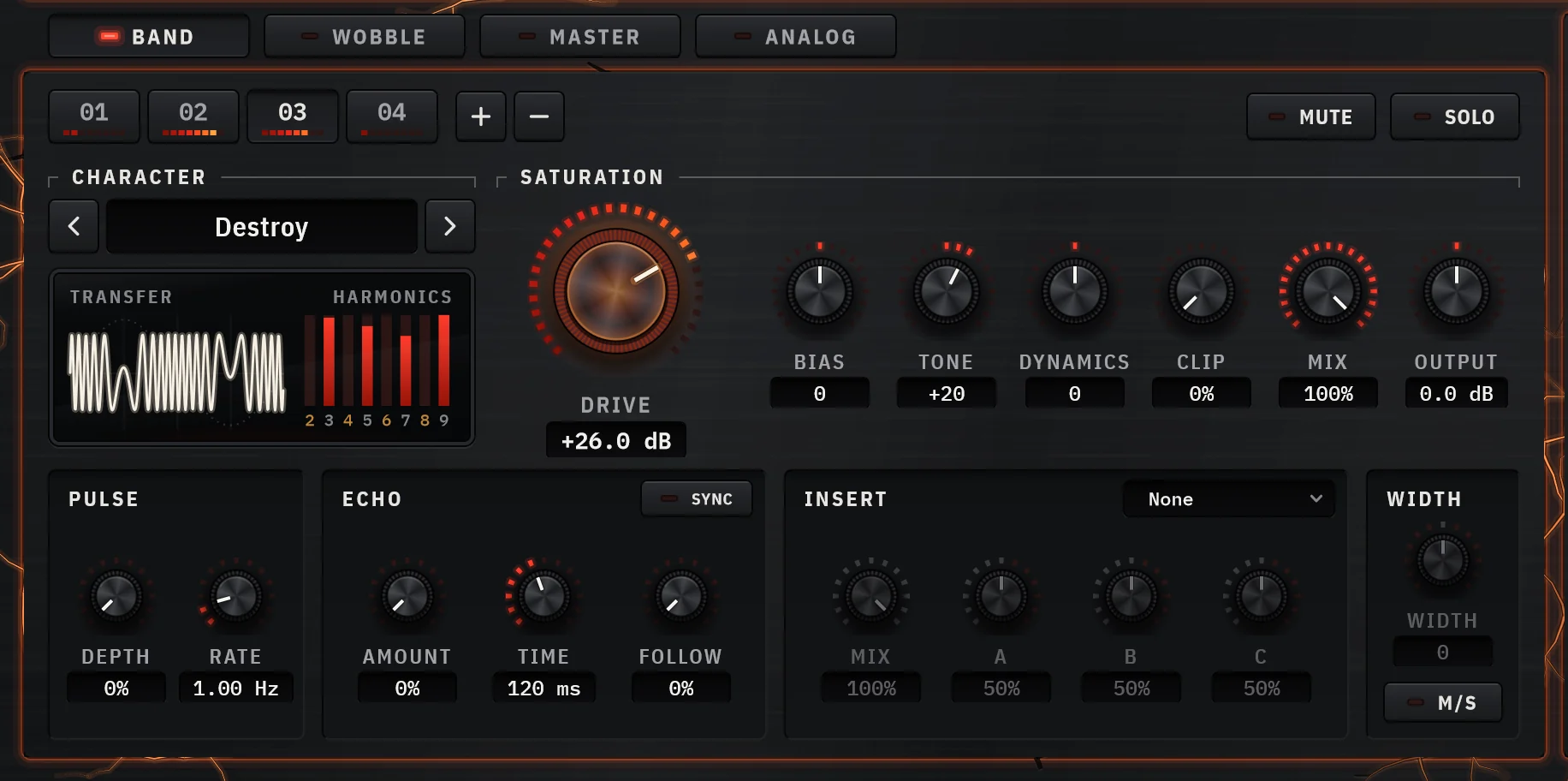
01Forgeby CrystalKarat
Multiband saturatorBest for: Seeing and hearing exactly what each curve adds
Every band in Forge shows its character’s transfer curve and the harmonics it is adding, live, as you turn the drive: the demo above is that display, running Forge’s own saturation code. Bias skews the curve for even harmonics without adding drive, so you can hear the difference between the two kinds directly. Delta swaps the output for wet minus dry through a phase-matched dry path, so you hear only what the saturation contributes.
The details in this article are built in rather than left to you. Clean Tape, Tube, Amp, both distortions and Soft Clip switch on antiderivative antialiasing as soon as they are driven into their curve; Warm Tape and Transformer shape an integrated flux signal, so bass saturates first; oversampling runs at 2×, 4× or 8×, minimum- or linear-phase, with the latency reported to your DAW. And because it is multiband, you can keep intermodulation in check by giving each register its own curve.
Why pick it
- Live transfer curve and harmonics for every band
- Bias for even harmonics, independent of drive
- Delta monitoring through a phase-matched dry path
- Antialiasing at 1×, and oversampling up to 8×
Know first
- Its curves are voiced, not circuit models, and there is no tape hysteresis model
- No AAX for Pro Tools yet
- Price
- $49 once, or by subscription · 7-day trial, no card
- Formats
- Windows VST3 · macOS VST3 and AU
Forge is ours: CrystalKarat makes it and publishes this blog. Everything else on this list is another company's, and nobody paid to be on it.
02Saturn 2by FabFilter
Multiband distortion and saturationBest for: Exploring many curves with modulation
Saturn 2’s 28 styles and its live display make it a good place to compare curve families, and its High Quality modes (up to 32× oversampling) let you hear what aliasing does by switching it off and on.
Why pick it
- Wide range of curves
- Oversampling up to 32×
Know first
- No harmonic readout per band
Mid-price · Also sold in FabFilter's bundles
FabFilter's page for Saturn 2 (opens in a new tab)03ChowTapeby Chowdhury DSP
Physically modelled tapeBest for: Hearing magnetic hysteresis, for free
ChowTape is a physical model of tape built on the Jiles–Atherton model of magnetic hysteresis, so it has the memory that static curves lack. Its source and the research behind it are published, which makes it the best way to learn how tape saturation actually works.
Why pick it
- Real hysteresis model
- Free and open source
Know first
- Tape only
- CPU rises with its oversampling
Free · Open source
Chowdhury DSP's page for ChowTape (opens in a new tab)04Saturateby Newfangled Audio
Spectral clipper and overdriveBest for: Hearing curve shape and symmetry on their own
Saturate’s Shape control sweeps from the softest to the hardest clipping curve and its Symmetry control adds even harmonics, which makes it a clean way to hear those two variables in isolation on real material.
Why pick it
- Two clear controls for shape and symmetry
- Budget price
Know first
- Built for loudness more than colour
For full roundups, see the best saturation plugins and the best distortion plugins.
Questions
What is the difference between saturation and distortion?
Intensity. Both pass audio through a curve that bends as the signal grows. Saturation is a soft curve driven lightly, adding a few low harmonics you mostly feel as warmth and density. Distortion drives harder, or into a harder curve, until the added harmonics are an obvious part of the sound.
What are even and odd harmonics?
Harmonics are new frequencies at whole-number multiples of the original. Even harmonics (2, 4, 6 times) are octaves and their relatives and sound warm and full. Odd harmonics (3, 5, 7 times) add presence and, at high orders, harshness. A symmetrical curve adds only odd harmonics; an asymmetrical one adds even harmonics too.
Why does distortion sound bad on major chords?
Distorting several notes together creates intermodulation tones. For a fifth, those tones fall on notes of the chord's own harmonic series, so the result sounds like a bigger chord. For an equal-tempered major third they fall slightly off, and the near misses beat against each other, which sounds muddy.
What is aliasing in a saturation plugin?
Saturation creates harmonics above the highest frequency the sample rate can hold. Those don't disappear: they fold back into the audible range at unrelated frequencies, which sounds grainy or metallic. Oversampling and antiderivative antialiasing reduce it.
Does saturation make a track louder?
Usually, yes. Saturation reduces the peaks more than the average level, so at the same peak the track is denser and louder. That is useful, but it also means a saturated signal will sound better in an unmatched comparison, so match the output level to the bypassed signal before judging.