How to mix kick and bass so they stop fighting
Why kick and bass clash, and how to fix it: decide who owns the sub, tune the kick, carve with EQ, duck with a sidechain, and keep the low end mono.
By CrystalKarat9 min read
The kick and the bass carry the weight of almost every modern mix, and they want the same thing: the bottom two octaves, in the middle of the image, at the same moment. When they fight, the low end gets louder and less clear at once, the kick loses its punch, and the bass notes blur. Here is how to make them take turns.
Why kick and bass fight
A kick’s weight is a short, pitched thump, usually somewhere between 40 and 100 Hz, with its click or beater well above 2 kHz. A bass line’s fundamentals sit in the same place: the low E of a bass guitar is 41.2 Hz, and the A above it is 55 Hz. Both are mixed to the middle of the image, so nothing separates them in space either. And low frequencies mask upwards, so whichever is louder down there also dulls the other’s body above it.
When they hit together, three things go wrong: their levels add, eating headroom; the bass note masks the kick’s thump for its first few milliseconds; and where their frequencies are close but not identical, they beat against each other, so the low end wobbles in level from note to note.
Decide who owns the bottom
Choose which of the two gives the track its lowest octave:
| Low end | Kick | Bass | Common in |
|---|---|---|---|
| Kick-led | Owns the sub, 40–70 Hz | High-passed under the kick, lives 80–250 Hz | Rock, house, techno |
| Bass-led | Short and punchy, 70–120 Hz and the click | Owns the sub | Hip-hop, trap, dubstep, 808 records |
| Shared, in turns | Full range on the hit | Full range between hits, ducked on them | Pop, drum and bass, most dense mixes |
Whichever you choose, everything else follows from it. Most kick-and-bass problems are two sounds that were both chosen to own the sub.
Tune the kick to the song
A kick drum has a pitch, and when it fights the key of the song the low end sounds muddy no matter how you EQ it. Find the kick’s fundamental with an analyser (the highest peak in its lowest octave), then pitch the sample to the root or the fifth of the song’s key. With an 808 or a sub-heavy kick, this matters more than any EQ move in this guide.
Carve with EQ
- High-pass the one that doesn’t own the sub. In a kick-led mix, a gentle high-pass on the bass just below the kick’s fundamental gives the kick the floor.
- Cut each one where the other peaks. If the kick’s weight is at 55 Hz and the bass’s body at 100 Hz, a few decibels off the bass at 55 Hz and off the kick at 100 Hz lets each have its own place. Small cuts on both work better than a deep one on either.
- Clear the low-mids of the kick. Many kicks carry a boxy region between 250 and 500 Hz that adds nothing but blur under a bass. Cutting it there helps the bass speak.
Sidechain: compression or EQ
When they must share the same frequencies, make them take turns. There are two ways, and they sound different:
- Sidechain compression turns the whole bass down on every kick. It is audible, and in dance music that pump is often the point. Fast attack, a release timed to the tempo, and a few decibels of gain reduction.
- Sidechain or dynamic EQ turns the bass down only at the frequencies the kick is using, so the bass keeps its growl and the kick gets its thump. It is close to inaudible, which is the point in most other genres.
Either way, the release decides how it sounds. Too short and the bass flutters back mid-kick; too long and it never fully returns before the next one.
Harmonics for small speakers
Phones and laptop speakers reproduce little or nothing below about 100 Hz, so a sub-only bass simply disappears on them, and the kick goes with it if it relies on the sub. Saturation adds harmonics at two, three and four times the fundamental, where small speakers work, and the ear rebuilds the missing low note from them. A bass that carries its own harmonics also needs less sub to be heard, which leaves more room for the kick. Our 808 saturation guide covers how to add them without losing the weight.
Keep the low end in the middle
Keep everything below about 100–120 Hz in mono, kick and bass both. Wide low end loses level when a club or a phone sums to mono, and it makes the two harder to balance against each other. Stereo synth basses are the usual culprit: narrow their lows and keep their width higher up. Soap’s field view shows how wide each frequency of a track is, so a bass that is wider than it should be below 120 Hz is easy to spot.
Check it before you call it done
- Listen in mono, then on headphones, then on the smallest speaker you have.
- Mute the bass for a bar. If the kick suddenly sounds twice as big, the bass was masking it.
- Compare with a reference in the same genre, level-matched, to hear whether your low end is kick-led or bass-led where theirs is.
- Watch the master’s true peak. If the low end is eating headroom, the two are still adding up on every hit.
Plugins for kick and bass
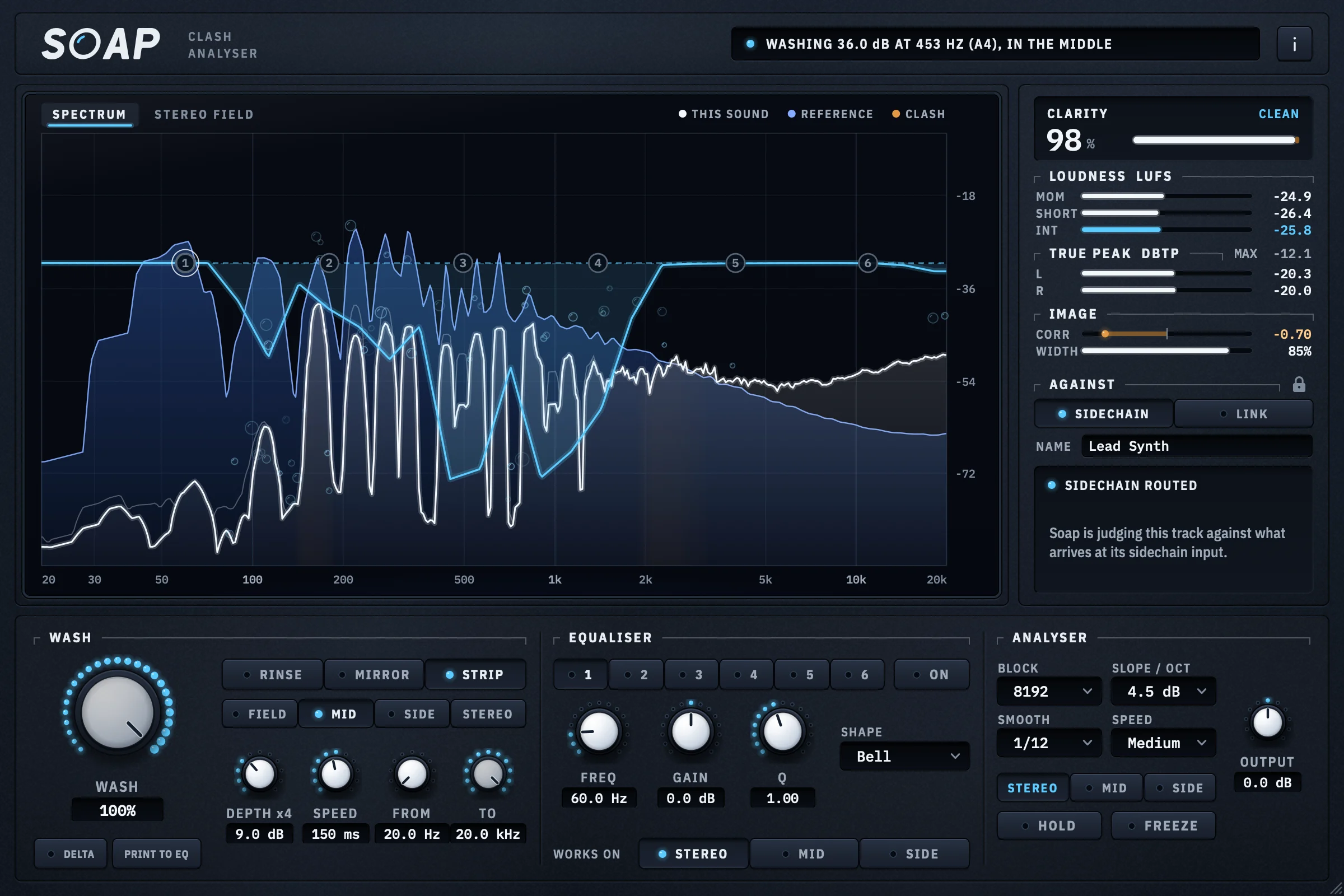
01Soapby CrystalKarat
Muddiness removerBest for: Seeing exactly where the bass sits on the kick, and ducking only that
Put Soap on the bass and route the kick to its sidechain. The display shows the bass in white over the kick in blue, fills the frequencies they share in amber, and the header names the worst clash with its note, so you know whether the fight is at the kick’s fundamental or its body. Hover anywhere for the frequency, note and level.
Then turn up the Wash. In Rinse it ducks the bass only at the frequencies where the kick is hitting it, and only as hard as they clash, with a speed control for how fast the bass comes back. That is the precise version of sidechain compression: the kick gets its fundamental, and the bass keeps everything above it. Delta plays only what is being taken out, so you can hear that it is the right part.
Why pick it
- Shows the clash with its frequency and note
- Ducks only the shared frequencies, with no latency
- Free, with loudness and true-peak meters beside it
Know first
- The Wash's bells are a third of an octave wide, broader than a surgical notch
- No AAX for Pro Tools yet
- Price
- Free, with a CrystalKarat account · Link with Studio Pass
- Formats
- Windows VST3 · macOS VST3 and AU
Soap is ours: CrystalKarat makes it and publishes this blog. Everything else on this list is another company's, and nobody paid to be on it.
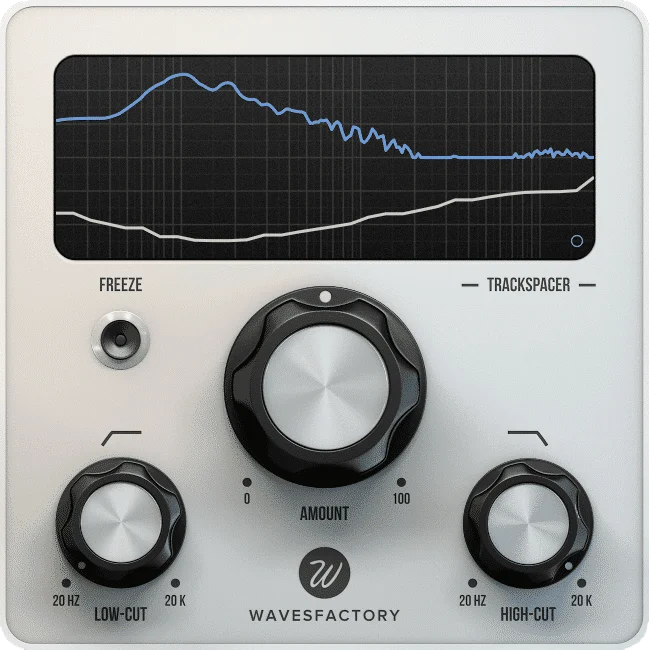
Trackspacer. Image: Wavesfactory 02Trackspacerby Wavesfactory
Sidechain-driven 32-band ducking EQBest for: Spectral ducking of the bass from the kick
Key Trackspacer on the bass from the kick, low-pass its sidechain so only the kick’s low end triggers it, and set a short release. The bass dips across the kick’s spectrum on every hit. It cuts the kick’s whole shape rather than only the overlap, so use less Amount than you think.
Why pick it
- Fast to set up
- Sidechain filters to focus the trigger
Know first
- Ducks the kick’s whole shape, not only the overlap
Budget · Often on sale
Wavesfactory's page for Trackspacer (opens in a new tab)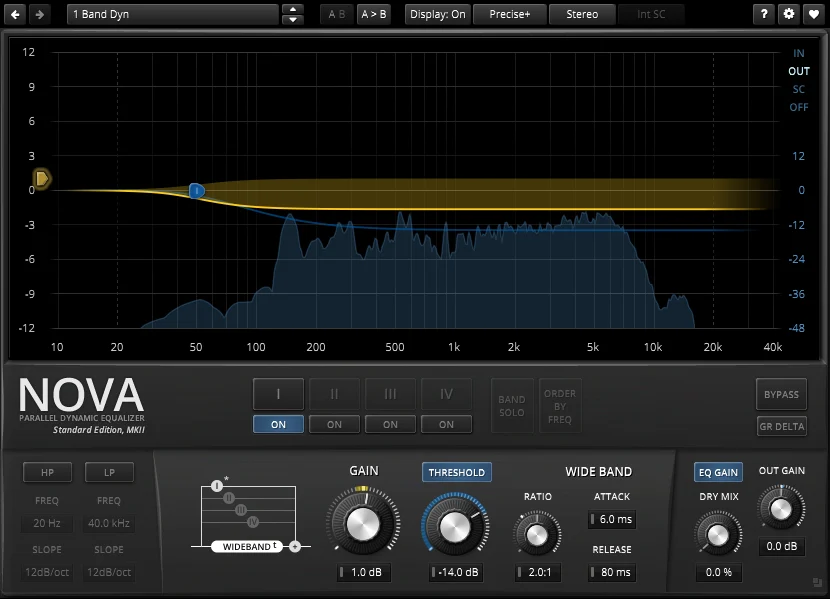
TDR Nova. Image: Tokyo Dawn Labs 03TDR Novaby Tokyo Dawn Labs
Parallel dynamic equaliserBest for: A free dynamic band keyed from the kick
One Nova band on the bass at the kick’s fundamental, keyed from the kick with a fast attack and a short release, does the classic kick-and-bass duck at a single frequency, free. It is the most transparent version of the trick when the clash is in one place.
Why pick it
- Free
- Cuts one chosen frequency only
Know first
- You find the frequency yourself
Free · The paid Gentleman's Edition adds more
Tokyo Dawn Labs's page for TDR Nova (opens in a new tab)
Questions
Should the kick or the bass be lower?
Either, as long as only one owns the lowest octave. In rock, house and techno the kick usually takes the sub and the bass sits above it; in hip-hop and trap the 808 or bass takes the sub and the kick is shorter and punchier. Decide first, then EQ and sidechain to match.
What frequency should I cut on the bass for the kick?
The kick's fundamental, which is the highest peak in its lowest octave, usually between 40 and 100 Hz. Find it with an analyser or by sweeping a narrow boost on the kick, then cut a few decibels there on the bass, ideally only while the kick plays.
Is sidechain compression or sidechain EQ better for kick and bass?
Sidechain compression ducks the whole bass and pumps audibly, which suits dance music. Sidechain or dynamic EQ ducks only the frequencies the kick uses, which keeps the bass's growl and is close to inaudible. Many mixes use a little of each.
Should the bass be in mono?
Below about 100 to 120 Hz, yes, and the kick too. Wide low end loses level when it is played in mono, and clubs and phones often are. Keep stereo width for the bass's upper harmonics instead.